
Tweet
| Navigation |
| Home |
| Site map |
| Articles |
| Contact |
| Links |
| Forum |









How to boost any solar panel output by 75%Here''s a really cost effective and simple way to get 75% more power from any ordinary solar panel. The theory: Most of the time a solar panel is working well below peak power, on hazy days and when the sun is lower in the sky, early morning, late afternoon for example. The light levels are just not high enough, so to boost the light level I tried aligning a mirror to reflect more light onto my solar panel. It worked really well and after a bit of experimentation I found that placing a mirror at least twice the size of the solar panel on the ground in front of the panel could boost the output by as much as 75%. 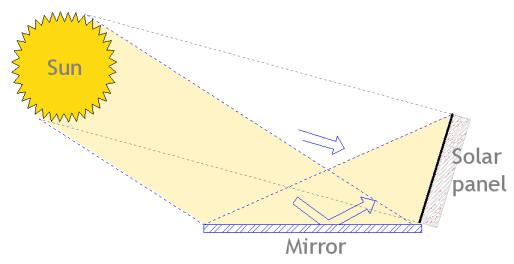 Using a bigger mirror can reflect light onto your panel over a longer period during the day so you don't need to track the sun, just face your panel and mirror due south. The practise: I bought a really cheap solar panel for £10.00 to test this idea, below are some pictures showing what I did and the meter readings just to show that it really does work. Pictured below is the 1.5w solar panel facing south just placed on a wood board to stop the grass shading the panel. The meter is showing 0.07 amps, that's approximately 0.84 watts, it's late October and even on a very sunny day the panel is only producing just over half it''s peak power. 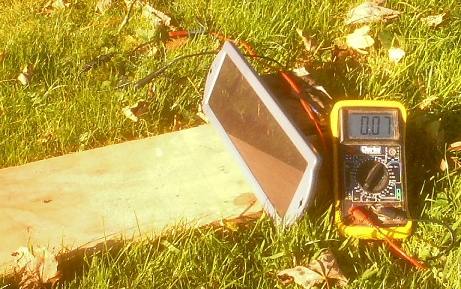 In the picture below you can see how the mirror reflects light onto the solar panel. The panel produced 0.12 amps, about 1.44 watts, very close to the maximum rated output for this panel. 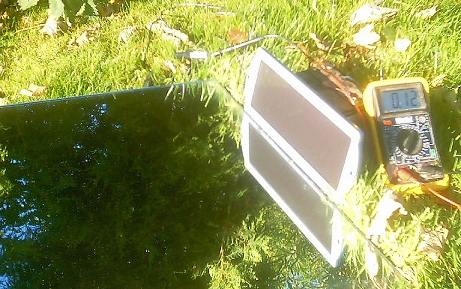 If you use a large mirror there is no need to align it to reflect light onto the solar panel just drop it on the ground in front of the panel for an instant 75% power boost. Conclusions: This is probably one of the cheapest and easiest ways to boost the power of a small solar panel, but this method does have some limitations:
Doing the math: Currently solar panels cost around £4.00 per watt so that makes a 20w panel about £80.00. A 75% increase in power is the equivalent of a 35w solar panel, which would cost about £140.00, that''s a saving of £60.00. Or a cost per watt of around £2.30 OK you have to find a mirror or polished sheet of metal but still it's a huge saving. Developing a low cost solar panel tracking system would further boost the efficiency but getting more light onto a solar panel on an overcast day could have the most potential benefit. I'll continue to test a few different panels with different set-ups and post the results below. |
|
 |
|
| [ comments 76 ] |
| posted by Colin | 22/12/2007 08:13:35 |
|
|
|
| Hi Paul I see you`re a mad scientist type too :) From the figures i guess its a 12v panel, i wonder if theres any merit in trying to lose the excess heat before it hits the panel? Something like a small aquarium filled with water to absorb the longwave radiation as a test? I think you`ll likely lose some light intensity but on the flipside you might gain some warm water :) | |
|
|
|
| posted by Colin | 24/12/2007 04:07:44 |
|
|
|
| With hindsight i think arranging the panels next to a shallow pool may be the solution. In theory, you should get reflection without the heat. Probably have to wait until next year to get some sun though :) | |
|
|
|
| posted by Brian, Michigan | 01/02/2008 22:40:18 |
|
|
|
| How about a combined heat and power application, using some of your DC to run a pump that takes water through a series of loops around the back of the PV, then dumps it into your hot water tank (parhaps using a small inline tank with a heat exchanger). They make stuff like this, but it's not used much yet. Cooling the panels isn't just good for longevity, you get a higher voltage and thus more power when the cells are colder. May be a bit more involved than you'd want to get though... | |
|
|
|
| posted by me | |
|
|
|
| anyone tried magnifcation and or spectrum filtration? btw cooling systems of somekind are a must have if you truely want to live off the grid | |
|
|
|
| posted by Admin | 31/10/2008 03:10:15 |
|
|
|
| Just found this great page on building a solar concetrator using an old sky dish.Click here | |
|
|
|
| posted by James | 08/03/2009 14:46:31 |
|
|
|
| Heating will certainly damage the panel. I bought some cheap 20W panels on eBay for £2.75 per watt but they are factory seconds so the don't give the advertised wattage. Computer modders have been cooling their over-clocked computers for many years. I wonder if something similar can help cool PV cells. The best for now is to use mirrors on overcast days and be greatful on sunny days without mirrors. | |
|
|
|
| posted by SKGiven | 18/06/2009 15:28:27 |
|
|
|
| You might want to try using a self made polarised mirror (sun glasses technology) - If you can get a strip of such plastic-like material and put it over a mirror? I know you can get polarised windows, which let most of the light in when it is cloudy, but relatively less when it is bright. In theory this should stabilise both the input of light and output of electric, thus facilitating the solar systems longevity (panel, regulator...): When it gets too bright, the mirror will darken and less light will hit the panel from the mirror, so it will not overheat, and will last longer! | |
|
|
|
| posted by mike | 18/07/2009 04:27:34 |
|
|
|
| i read that it limited lifespan when using mirrors. But maby watercooled with mirrors? | |
|
|
|
| posted by Dan | 31/08/2009 16:29:09 |
|
|
|
| Perhaps just using some cheap shiny white plastic material would be better. I guess it would be similar to using photovoltaic panels in a snow covered environment which reflects loads of diffuse light, remember snow blindness etc. | |
|
|
|
| posted by cobe | 08/09/2009 15:18:10 |
|
|
|
| you could place the solar panel in cooking oil as oil dosnt conduct electricity but is very good as an insulator | |
|
|
|
| posted by lee | 17/09/2009 13:48:47 |
|
|
|
| The diagram shows the sun giving off light in a different angle to the mirror than to the pv. In actual fact it is so far away from earth it arrives in parallel lines to both. This will affect your ideal positioning of the mirror. I read a report on electronicspoint website of someone spraying water over his panels and gaining 10% by cooling | |
|
|
|
| posted by Fergus | 26/10/2009 11:53:01 |
|
|
|
| Great idea. I understand that PVs can overheat, reducing their performance and longevity, but... here in the UK we have less than half the insolation than southern Spain. If PV manufacturers recommend the use of their panels near the equator without mirrors, surely it stands to reason that using them in the UK with a mirror that increases light onto the panels by up to 100% would work without damage. Or do installations in hotter countries gnerally include overheat protection? | |
|
|
|
| posted by mamos | 08/11/2009 23:12:54 |
|
|
|
| What about a heatsink of some sort on the back of the panel. For a fantastically simple yet effective sun tracking system check out DIY 12 volt solar power by Michel Daniek The man is a genius mamos | |
|
|
|
| posted by thewindmillman | 17/11/2009 16:15:03 |
|
|
|
| i have done this expirement and got similar results i also have found that if the panel is kept coolby running cold water over it lightly it power producing abilities again rise so0 good on you sir thought i was the last nutter on the planet of you use an old satalite dish rapped in aluminium foil as a parabolick mirror you can also use like an inverted magnifing glas on to solar panel also email me your mad enough to land on the free electric for the planet together we may do it tomorrow regards thewindmillman | |
|
|
|
| posted by cyprelda | 07/12/2009 23:49:24 |
|
|
|
| Get the government or private body to send up a sattelite in a set position with reflecting material then everyone would benefit. | |
|
|
|
| posted by Russell | 06/01/2010 10:17:44 |
|
|
|
| Even if you have your panels on your roof you can still use a reflector to increase sunlight onto the panels. I use a vertical reflector at the back of my flat plate solar hotwater system to increase sunlight onto the plate, especially in winter. When I get some PVs installed soon, I may do something similar, but only in the cooler six months of the year. I also am thinking of using an oscillating sprinkler to keep the panels cool in summer, which here in western Sydney can reach 35c ambient temperatures, which equates to a panel temperature of 60+ degrees. | |
|
|
|
| posted by myamberdog | 06/01/2010 20:26:10 |
|
|
|
| I have a different problem - I have 2 of my 20 basically flat angled panels shaded by a new LARGER air-conditioner that was installed last year (panels being on the north side of course) and i noticed the daily WINTER production went from 7 kwh to a little over 3 kwh. My idea was to build a vertical mirrored flat surface, behind and at a right angle to the panels. I was going to put mylar over plywood???X!!! And i would take it away in the spring when the sun clears the A/C obstacle. My dealer is concerned about panel burnout, too, which would invalidate the 25 year warrantee I'm about 6 years in to. I also live in Palm Springs, CA so have to definitely be careful about heat buildup - what does anybody think? | |
|
|
|
| posted by myamberdog | 06/01/2010 20:30:53 |
|
|
|
| ......lol.....how funny Russell you would post this at my exact time of posting....although mine was for PV's yours was the solar water heating panels......we get 110 Fahrenheit easily for a least a couple months in our summers and i've never had less than 15-16 kwh produced each day...and as far as i know, no heat problems.... | |
|
|
|
| posted by Admin | 06/01/2010 20:49:46 |
|
|
|
| Sounds like a great idea myamberdog, as far as heat goes I would think as long as you don't exceed the max output of the panel heat shouldn't be a problem. I honestly can't see any reason why a panel would be damaged by a little extra heat. | |
|
|
|
| posted by daan | 16/01/2010 14:23:05 |
|
|
|
| How about using a moving mirror, that directs the sunlight towards the pv panel, without ever shading it and to simply beam the ligth somewhere else once the PV panel becomes overheated?? | |
|
|
|
| posted by daan | 16/01/2010 16:03:55 |
|
|
|
| Hi, great ideas. Why not make an Arduino based aiming mirror that concentrates sun at the panel. When the sun is to strong it takes the beam of the panel. | |
|
|
|
| posted by pieter | 24/01/2010 20:42:51 |
|
|
|
| Has anyone done some study, as to what temperature is too high, how much temp the mirrors add, and at what rate of temperature, would say, a panel in Canada run at. It does make sense to take away additional heating in mid-summer, but after that it's hard to believe there would be an issue. | |
|
|
|
| posted by Russell | 22/02/2010 11:11:40 |
|
|
|
| Most PV panels ratings are stated at a panel temperature of 25c, in real life most panels will operate at surface temperature well above this. I have seen youtube sites where the panel surface temp was at 66c with an ambient temp of 38c. My feeling is that the panels will produce a lot more power if we can keep their surface temp as low as possible in the real world. | |
|
|
|
| posted by daan | 26/02/2010 17:24:10 |
|
|
|
| I live in the netherlands and high temperature is hardly the issue. I think it is very interesting to boost the amount of light on the panel. I will make some prototypes to test the concept. There must be data though about maximum operation temperatures | |
|
|
|
| posted by Eric Johnston | 08/03/2010 03:18:07 |
|
|
|
| The original results are flawed since Power is Volts*Amps and 0.07 amps is only 0.84 watts _IF_ the voltage is 12 volts, but at the shunt resistance of a meter in 'current' mode (usually < 1 ohm) the voltage will NOT be 12 volts, but probably down around 0.5 volts. Please refer to wikipedia for information on 'maximum power point' load for a solar cell. I did an experiment and checked the voltage with and without mirrors at up to 12 load resistance settings (using a decade box) and found that one mirror of about 3x the width of the solar cell at an angle to match the mirror's reflection to the solar cell area (about 20 degrees) only gave about 25% increase at the max. power point for each light level. Better than nothing since mirrors are cheap, but most PV installationss use MPP trackers so can only benefit so much. With twice as much mirrors, I didn't see ANY increase in the maxiumum power, but that was because the temperature went so high. With water cooling (PV thermal hybrid) it might be possible to use more mirrors. | |
|
|
|
| posted by daan | 12/04/2010 12:17:06 |
|
|
|
| Hi. I think we need much more data and testing to completely understand this. I will soon do this. I made a design for a flat mirror based product that can actually fit on a roof. I wonder what you think of zininzelfdoen.ning.com/forum/topics/solarrib-a-design-based-on | |
|
|
|
| posted by Dave North | 14/05/2010 19:47:05 |
|
|
|
| I want to fit a pv cell to a narrowboat (canal boat). For reasons of practicality it will have to be mounted flat on the roof, but maybe I can boost output with a mirror which folds down flat when not in use. Comments? | |
|
|
|
| posted by James | 20/06/2010 16:45:49 |
|
|
|
| I have placed copper tubing on the back side of PV panel to extract the heat. When I replace my hot water heater I kept the old one. I use the old hot water heater in series with the new one. I use the panel to preheat the water in the old hot water heater. I am getting 380 watts from a 160 watt solar panel for 6 hours a day plus the hot water. with all this it will still take 2 to 3 years to recope my investment. | |
|
|
|
| posted by Jay | 27/10/2010 03:24:44 |
|
|
|
| Cool. Such great Ideas. I've been driving myself mad at school wondering if you could have a field of mirrors directing the suns rays to a focal point (solar panel). Obviously overheating is a problem. JAMES - How exactly did you attach the copper tubing (or wires) to the back of your panels? Do you have a photo? Thank you - justinmming@gmail.com | |
|
|
|
| posted by Val | 05/11/2010 16:43:42 |
|
|
|
| I was wondering if a combination of fresnel and mirrors would increase the wattage and maybe place pv in a container with copper coil underneath to use for hot water system, also for cooling pv's. I'm on an engineering course and have chosen to use solar power as my project so any data and ideas you guys have collected would be great. I am based in uk and am keen for uk'ers to tap in to the solar source!!. Thanks guys and gals?? cyberhoiney007@aol.com | |
|
|
|
| posted by danphobic | 12/11/2010 12:10:49 |
|
|
|
| Hey guys, found this page by googling this idea. Weirdly I did exactly the same thing recently in my living room. With a long mirror and the exact same mini solar panel from maplins! I used a mini electric motor(phone vibrator) to demonstrate the increase in the energy and had amazing results. I could change the pitch of the motor by angling the mirror, great fun! To the above poster, yes fresnel lenses are being used by a company that has designed superheated solarPV cells with special cooling material. Obviously any normal PV would melt when exposed to the heat generated by a fresnel. My mind still boggles that all UK PV would not have backboard reflectors included as standard as in the picture above. It just makes so much sense when you consider that mirrored material is so cheap. My idea was to have mirror tiles covering the sun exposed areas on house walls which all swivel individually tracking the sun onto a singular point in the garden, like a giant parablic dish but using your homes walls. | |
|
|
|
| posted by Applesauce 4 | 22/11/2010 22:26:59 |
|
|
|
| Nice theory, bro. My science fair topic is on increasing the solar energy output, or efficiency, so thanks. I get your drift. | |
|
|
|
| posted by Apple Sauce | 25/11/2010 18:49:15 |
|
|
|
| Dude, for my science fair project you saved me a bunch because i had the same idea and everything, but i wanted more sources so this is another. Plus, i didn't know how to angle the mirrors... If you go to radioshack and buy their $15 solar cells,then go to Michaels and buy some small mirrors, you can have a science fair project easy. | |
|
|
|
| posted by Peter Panels | 28/11/2010 18:39:03 |
|
|
|
| If I installed additional equipment ie reflectors on my roof the local planning authority would say it contravened the planning laws governing solar panels which are lax at the moment. | |
|
|
|
| posted by Willl T | 06/12/2010 19:51:05 |
|
|
|
| I been doing this for a while now. its prettty obvious. works great in winter when you want to point the soalr panels closer to the horizon, and in peak summer just remove the mirrors. Fine in northern latitudes like scotland where normal PV is not cost effective. Would do it in France as the heat would fry the panels. White surfaces will give you about 90% reflectivity if your worried about 'mirrors' blinding pilots or something. | |
|
|
|
| posted by piyush | 23/01/2011 15:28:16 |
|
|
|
| any one have a idea for use LED as solar cell. i know the out put is low but never damage panal | |
|
|
|
| posted by jabri | 21/03/2011 15:42:12 |
|
|
|
| how to optimize the mirror tilt in order to have maximum solar photovoltaic panel added | |
|
|
|
| posted by el`tel | 28/03/2011 19:54:47 |
|
|
|
| anyone tried a light intensifier?... | |
|
|
|
| posted by Rokel | 20/05/2011 16:11:47 |
|
|
|
| Maybe those laptop heat packs are good use here? That is gel in bags to transfer heat away from cells to water cooling system. Maybe we should not strife for peak wattage at noon but protect the cells (using blinds/flaps/screens/shade) and pick up more watts in the morning and evening. | |
|
|
|
| posted by Blackswan | 01/06/2011 10:02:56 |
|
|
|
| The heat problem looks like a storm in a tea cup to me. Firstly, a mirror having a silver or polished aluminium reflector will only reflect visible light, not infra-red (which contains most of the heat). The mirror therefore holds most of the heat itself and doesn't reflect much heat onto the pv panel. Secondly, in the UK, the Summer Sun is relatively weak, so maybe you can just ignore this problem of heating. In Australia, where the Summer temperature rises to 100F for several weeks of the year you would need to cover the mirror or devise a special wave-guide to shelter the mirror in Summer but not at other times. | |
|
|
|
| posted by Mad Mark | 09/07/2011 01:32:38 |
|
|
|
| Infrared can be absorbed and reflected by objects much the same way as visible light.UV a and UV b are more hard to reflect,I have done a lot of work on parabolic solar equipment using a Fusionseeker tracker,I live in the UK so the problem would not be so bad,but for the cooling of the PV I would use Paratherm heat transfer oil in front of the unit, and a heat pipe to transfer the heat into a convection piping to feed a second pre-heat water tank for your main hot water tank, the losses on the panel will be mostly heat and 10% reflection,better to get some pre heat hot water, you could run this setup all year round | |
|
|
|
| posted by kennedy | 12/07/2011 14:28:08 |
|
|
|
| i think that energy conversions can play an important role in the way of our use of energy-of any sort! | |
|
|
|
| posted by mike | 17/07/2011 15:25:55 |
|
|
|
| the suns rays may be parallel if absolutely no matter bent the light, but there are particles in space and above all, the water vapor in the earth's atmosphere bends the light significantly more. i'm not the one to say it's as bad a difference as being underwater vs on the surface, since I have not been in outer space to compare the difference in sun's light angle from before it enters the earth's atmosphere. | |
|
|
|
| posted by andy | 23/07/2011 10:56:09 |
|
|
|
| Although the idea is genial in its simplicity with a mirror light reflection & refraction parameters change and acute budget analysis,a lot of technical problems must be solved see jason daan posts first compatibility with panel,without overatin,life span decrease etc,weather complications and maintenance issues.This trick probably works at its best if you can add or remove easiliy mirrors depending on radiation intensity eg winter mirror,summer no mirror and ideally with some sort of solar tracking system better if automated I thin a g8 help may come from reviewin light basic physics Ifound in book that mirrors can be plane or spherical with different reflection,this maybe can hel .I dont think cooling the panel is a smart idea simply because you waste some already gained energy rather that heat may be used for bathroom kitchen sanitary water.Finally getting mirror culture will help am already browsing the web looking for bargains I found some very cheap plastic mirrors | |
|
|
|
| posted by andy | 23/07/2011 11:08:07 |
|
|
|
| Looking at the costs of materials, what about using alluminum foils? Those do cost a lot less than a cheap mirror,so you may even gain in application surface | |
|
|
|
| posted by Musa Jega | 11/08/2011 16:59:46 |
|
|
|
| I am an M.Sc. student from Nigeria where solar illumination is not a problem but the use to be between 35 oC to 40 oC which highly affect the performance of solar panels. I am intending to use the same principle but in case I want to shade the solar panel leaving the reflecting mirror in direct solar radiation to reduce the panel temperature. Please guys advise if this system will work. | |
|
|
|
| posted by Jazzsaxman | 15/08/2011 03:25:21 |
|
|
|
| Spain has very large solar farms that use mirrors to direct the sun onto a tower which produse steam to drive turbines. Perhaps this is the way to go. Probably cheaper to build. The mirrors there get so hot that they have to spray them with water to cool them down. Have you ever applied for planning permission to put up a small turbine. You have not a hope in hell unless you live in the sticks. I reckon the solution is held in dark matter. If we can find it. Very interesting and informative article. | |
|
|
|
| posted by johno | 18/08/2011 01:57:08 |
|
|
|
| well thanks that explains why when i added a panel to the front of my windscreen and park due south at work it produced a greater output, shall try adding tinfoil next on the bonnet , as long as it does not effect the driving ... | |
|
|
|
| posted by Peter Webb | 11/10/2011 23:19:50 |
|
|
|
| Putting intensifiers on standard PV panels is fine and really does work well, one problem we have encountered was cell denigration caused by operating the panels at much higher temperatures which can bring the temperature well above the SOA that the panels were designed for, unless the heat can be taken away, we ended up heating water and achieved water temperatures well above boiling point meaning we had to use a pressurization system, we found that we were only getting three to four years out of the panels and no guarantee from the panel manufactures manufactures , look forward to any comments. | |
|
|
|
| posted by Alan Loveridge | 16/10/2011 20:44:06 |
|
|
|
| Maybe you could elevate the solar panels high enough you could spin the mirror with a motor controlled by a computer hooked up to a outside temperature gage with a sunlight and wind speed gage. Thus the program could turn the mirrors off by spinning the mirror to the back side when conditions would hurt solar panels life. | |
|
|
|
| posted by Nor Kavon | 10/12/2011 05:58:25 |
|
|
|
| The heat at issue is not caused by infrared light but by the electrical current generated in the panel. Send a lot of power in a small wire and the wire gets hot. If the panel is generating power in excess of it's rating, then it may not be dissipating the extra heat very well. So besides normal heat issues, if a 80W panel is producing 120 watts (because of using mirrors) then additional cooling will not only prolong the life of the panel but increase the output even more (since heat in wires also creates resistance). | |
|
|
|
| posted by Roger George | 11/12/2011 00:26:51 |
|
|
|
| Earth receives energy from the sun at an average of about 350 w/sq m. This equates to about 500 w/sq m at midday at lattitudes such as N. Scotland, and about 20% more in southern England. A commercial solar PV panel rated at 90 w has a total area of 0.66 sq m (active area is about 0.56 sq m) and will therefore absorb about 390 w at midday in summer in a cloudless area of southern England, but only produce about 90 w of electric power. On a typical cloudy winter day in the UK, less than 10% of the sun's light reaches the ground. As already observed, increasing the input with a mirror also increases the temperature proportionally. Using one or more lenses to concentrate the light is useful only when their area is greater than that of the panel, and they are not sharply focussed on the panel Placing an infra-red filter in the light path will not improve the situation since about 88% of the sun 's energy is in the visible spectrum, leaving about 6% each in the ultra-violet and infra-red ranges. Until materials are developed that have a much higher conversion efficiency, solar PV panels will always get hot under full-power conditions. As already pointed out, using them also in the non-PV mode with water cooling can harvest almost all the incident energy . The next steps are to couple the panel(s) to a rechargeable battery (e.g. 12 V) and design a cheap 50 hz inverter (230 v in the UK) to supply power to the home, which is almost where I was some 50 years ago designing dc-dc converters. Good luck! | |
|
|
|
| posted by Abiud | 24/12/2011 08:53:15 |
|
|
|
| The idea of using a mirror is good and cheap especially 4 those who can not afford to purchase expensive materials.i wish to use that idea of a mirror can someone shed more light.my panel is on the roof facing the sky so how can i put a mirror reflect sunlight direct without shadow? I will appreciate.Am in Zambia. | |
|
|
|
| posted by BroHill | 26/01/2012 01:37:30 |
|
|
|
| I have a 1.5 Kw system on my roof for the last 8 months.The out put so far is 1600 kwhs . The system is rated at 1.5 kw at 25 deg. celcius. If the temperature is above this the rating reduces below 1.5 Kw. The panels produce more on a cool day. So a mirror will raise the temp. of the panel and reduce output. In a cold climate this not a problem, I live at 32 deg latitude in Australia,temps upto 40 | |
|
|
|
| posted by Thunderstorm | 13/02/2012 21:17:06 |
|
|
|
| Here's some info, if you ad peltier heatpumps at the back and a heatsink the peltier heatpumps can convert the heat into electricity as well giving you more power. By the way the peltier heatpumps works both ways give it electricity power and it cools,give it heat it gives electricity power. | |
|
|
|
| posted by Big Al | 25/02/2012 14:30:56 |
|
|
|
| Stumbled on this site by accident. Lots of good ideas - just need a few solutions.My question is very basic.At what temp would a normal pv mounted on the roof become non-viable due to low output or outright failure.Also a spray pump mechanism would be fine connected to a temp sensor and be powered from pv system but wouldn't that be a case of robbing peter to pay paul\All very well to gain an extras few watts bt cooling but if its costing that in pump power or solenoid operation, wot would be the point.FYI. Siemens quote all energy received from the sun in eight minutes on earth would power world needs for one whole year. Keep Thinking! JHB South Africa. | |
|
|
|
| posted by peterb | 25/05/2012 02:05:47 |
|
|
|
| A single large radius tracking convex mirror could cover a lot of panels with minimal heating... | |
|
|
|
| posted by maruf | 14/06/2012 10:43:26 |
|
|
|
| lots of idea i got here.wound u mind informing me how spain collecting sun heat for turbine. | |
|
|
|
| posted by Electromechanics | 02/08/2012 12:08:13 |
|
|
|
| Hello all, I am studying this subject at the moment in university (that does not mean I am an expert yet!) We have set up an experiment to try and analyze the benefits. We are based in the UK and so far the mirror system is receiving more irradiation than the a standard installation (no surprise) and and almost as much as a single axis tracker. The experiment has only been running for a month now so early days. Does anyone on here know of any peer review research carried out on this subject? | |
|
|
|
| posted by André | 07/08/2012 19:32:27 |
|
|
|
| All these complicated computer-based ideas for controlling rotating mirrors. People forget that the earth rotates like a clock? You only need a one rotation per day driver. And a reset after sun-down. You are not tracking low-flying planes :) The main mirror should also be wider than the solar-panel. When the sun comes from left or right of the centre it can be enhanced too. Also there could a mirror panel at the top of the panel. Easiest would be to use a board with aluminium foil. Or a PE foam pane with aluminiumfoil fixed to it. Nice and light. The main problem is to make it firm against water and wind. | |
|
|
|
| posted by Aaron | 19/12/2012 16:19:17 |
|
|
|
| These are all good ideas, and you all obviously know more than I do. But I was wondering if it would be affective to place a small fan near the panel to cool off the surface and thus maintain full energy absorbtion? Would this not cool the surface of the panel without reducing the solar energy absorbed? Thoughts?? | |
|
|
|
| posted by JP | 18/01/2013 18:29:24 |
|
|
|
| I have a large array in the backyard (14KW)and I'm looking into reflective surfaces in front and also vertical behind the second row of panels. The issue with spray cooling and such is that the mineral content in the water may in fact damage your panels long term. I would NOT want to be spraying water on them for months on end. Yes it works fine for a few minutes to prove it works. That is a known. No the more likely solution long term is to use a clear fluid that can absorb the heat yet not impede the sunlight and use natural convective forces to get the fluid moving. No pump involved and you could capture the heat generated in the fluid through a heat exchanger to pre-heat the water for the homes hot water delivery system. | |
|
|
|
comments will be accessed through the forum in the new site design (coming soon)
55463
Copyright © 2007- 2014 geo-dome.co.uk. All Rights Reserved.