
Tweet
| Navigation |
| Home |
| Site map |
| Articles |
| Contact |
| Links |
| Forum |









Vetilation in dome structuresWith some simple good building practice you can make your dome a comfortable, fresh and healthy space to be in. Look at the diagram below to see an example of a properly ventilated dome structure. 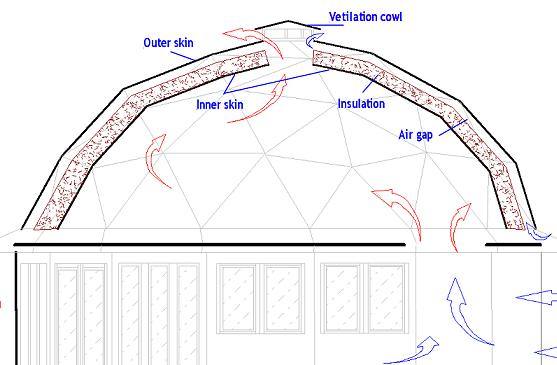 Ventilation cowl: I would highly recommend building in an air vent at the top of a dome, warm moist air rises and if you don''t provide an escape the humidity will dramatically increase encouraging mould and mildew growth. I would also recommend some trickle vents low down in the dome; this lets cool dry air in at the bottom to replace the moist air leaving the top vent. If you''re bothered about heat loss you can build a heat exchanger into the system to warm the incoming cool air with warm air leaving the building. Ventilation in the skin: Warm air holds much more moister than cool air so when warm moist air is cooled the water has to go somewhere, it goes through the inner skin, then through the insulation and finally hits the waterproof outer skin were it condenses on the cool surface. In the diagram above you can see how moister that passes through the inside skin and insulation can be carried away by air entering at the bottom of the air gap and exiting through the ventilation cowl. If your building a geodesic dome from a kit, be sure to ask the supplier what provision has been made to take care of structural ventilation, if your self building skimp on ventilation costs at your peril. The human body evaporates several litres of water a day, more with exercise. Cooking, washing, indoor plants, drying clothes etc can easily bring the total up to a gallon or so a day! Just make sure it has somewhere to go. |
|
 |
|
| [ comments 4 ] |
| posted by Dr. John Michael Christian | 12/01/2011 10:55:10 |
|
|
|
| Very interesting article.. thank you. I've been planning a dome and have decided to go with a geodesic rather than the monolithic I'd been considering, so this is a valuable consideration. Best regards, Dr. John Michael Christian spontaneousawakening.com theorganicgardeningblog.com | |
|
|
|
| posted by Marius Moga | 05/09/2011 21:54:39 |
|
|
|
| I am making a dual dome for home. Is 15m long and 8m wide.I want to show you but I cannot put the picture in coment. I have made the air gap but I do not know how to make technicaly the air vent from inside dome to out. If somebody know, please help! | |
|
|
|
comments will be accessed through the forum in the new site design (coming soon)
10399
Copyright © 2007- 2014 geo-dome.co.uk. All Rights Reserved.